
Gold testing is an important part of buying, selling, valuing, and verifying gold jewelry and other precious-metal items. For many years, traditional touchstone testing has been widely used to estimate gold purity. However, advances in technology have introduced more precise and convenient testing methods.
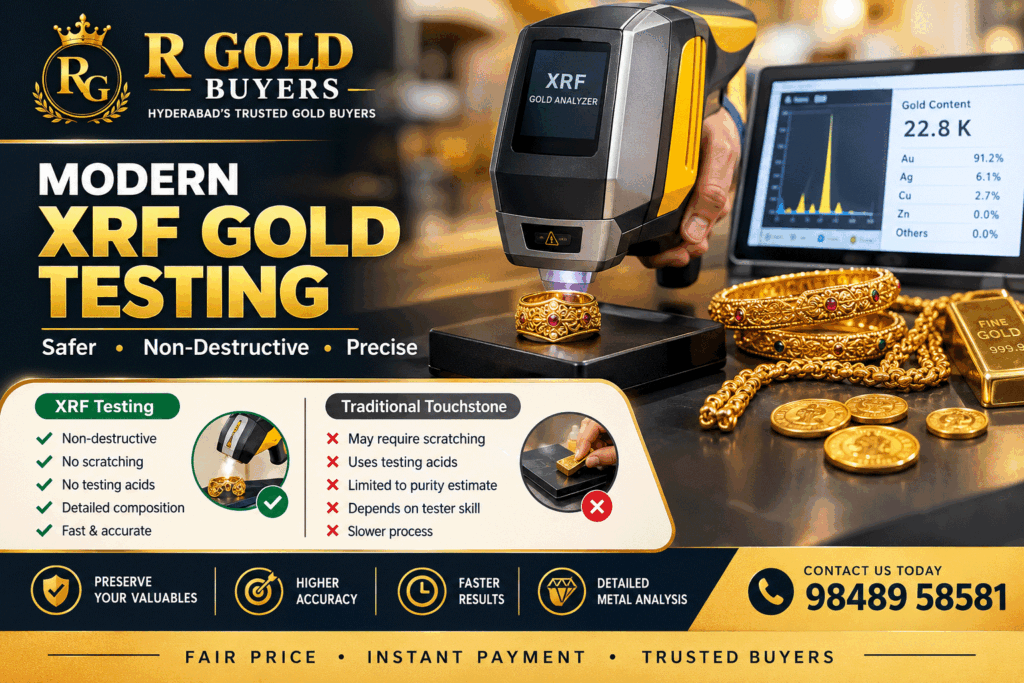
One of the most widely used modern technologies is XRF gold testing, which uses X-ray fluorescence to analyze the composition of a metal item. Compared with traditional touchstone methods, XRF testing can provide a non-destructive way to assess gold purity while reducing the need for physical scratching or chemical testing.
What Is Traditional Touchstone Gold Testing?
The touchstone method is a traditional technique used to estimate the purity of gold.
During this process, a gold item is rubbed against a dark testing stone to leave a visible streak. The streak is then compared with marks produced by gold samples of known purity. Testing acids may also be applied to help determine the approximate karat level.
While this method can be useful when performed by an experienced professional, it has some limitations.
Common limitations include:
- The item may need to be scratched or rubbed against a testing stone.
- Testing acids may be required.
- Results can depend on the skill and experience of the tester.
- The test generally provides an estimate rather than a complete elemental analysis.
- Plated or layered items can sometimes make testing more complicated.
- The process can be less convenient for testing multiple items.
What Is XRF Gold Testing?
XRF (X-ray fluorescence) testing is a modern analytical technique used to identify and estimate the concentration of elements in a material.
An XRF analyzer directs X-rays toward the surface of the gold item. The material responds by producing characteristic fluorescent X-rays. The instrument analyzes these signals to determine which elements are present and their approximate concentrations.
For gold testing, this can help identify the percentage of gold and other metals in an alloy.
For example, a gold alloy may contain gold along with silver, copper, zinc, or other metals. XRF technology can help provide a detailed composition report without requiring the item to be cut or damaged.
Why Is XRF Gold Testing Considered Safer?
The biggest advantage of modern XRF testing is its non-destructive nature.
1. No Scratching of the Gold Item
Traditional touchstone testing can involve rubbing the jewelry against a testing stone, which may leave a mark or remove a very small amount of surface material.
XRF testing generally does not require this type of physical abrasion. This makes it particularly useful for valuable jewelry, coins, ornaments, and other items where preserving the original condition is important.
2. No Need for Testing Acids
Traditional testing can involve acids designed to react differently with metals of different purities.
These chemicals require careful handling and appropriate safety precautions.
XRF testing can reduce the need for such chemical testing because the analyzer evaluates the material using X-ray fluorescence rather than relying on an acid reaction.
3. Non-Destructive Analysis
One of the most important benefits of XRF technology is that the item can generally remain intact after testing.
This is valuable when evaluating:
- Gold jewelry
- Coins
- Bullion
- Decorative gold items
- Antique pieces
- Precious-metal components
Preserving the item can be especially important when its condition contributes to its overall value.
4. Fast Testing
XRF analyzers can typically provide results within a short period of time. This makes the technology suitable for businesses that need to test multiple gold items efficiently.
Instead of relying entirely on a manual comparison process, the operator can use the instrument to obtain an elemental analysis quickly.
5. More Detailed Metal Composition
Touchstone testing primarily focuses on estimating gold purity through visual and chemical comparison.
XRF testing can provide information about several elements present in the tested material. This can give buyers, sellers, jewelers, and gold dealers a more detailed understanding of the alloy.
XRF Testing vs. Touchstone Testing
| Feature | XRF Gold Testing | Traditional Touchstone |
|---|---|---|
| Physical scratching | Generally not required | May be required |
| Chemical acids | Generally not required | Often used |
| Testing approach | Instrument-based elemental analysis | Visual/chemical comparison |
| Damage to item | Generally non-destructive | Can leave a mark |
| Speed | Fast | Depends on the tester |
| Composition information | Can identify multiple elements | Primarily estimates purity |
| Operator skill | Requires trained equipment operator | Highly dependent on tester experience |
| Suitable for valuable items | Yes, particularly when preservation matters | Requires greater care |
Does XRF Testing Guarantee 100% Accuracy?
Although XRF testing is a powerful analytical technology, it is important to understand its limitations.
XRF primarily analyzes the material near the surface of the item. If a piece has plating, coatings, solder, or unusual construction, the result may not always represent the composition throughout the entire object.
Therefore, testing conditions, instrument calibration, sample preparation, and operator expertise can all affect results.
For high-value transactions or situations where the internal composition is critical, additional testing methods may sometimes be appropriate.
Why Proper Calibration Matters
An XRF analyzer is only as reliable as its calibration, maintenance, and operation.
Professional gold-testing businesses should use appropriate calibration standards and follow the manufacturer’s operating procedures. Regular maintenance and quality-control checks can also help ensure consistent results.
This is why choosing a reputable gold-testing service is just as important as choosing the technology itself.
Benefits for Gold Buyers and Sellers
Modern XRF testing can make gold transactions more transparent and convenient.
For sellers
A non-destructive test can help preserve the appearance and condition of jewelry while providing useful information about its composition.
For buyers
An independent test can provide greater confidence that the gold item is being evaluated based on its measured composition rather than only visual appearance.
For gold businesses
XRF technology can improve testing efficiency when multiple items need to be evaluated. It can also provide useful records of the composition of different items.
XRF Testing and Gold Purity
Gold purity is commonly expressed using karats.
For example:
- 24K – traditionally associated with very high-purity gold
- 22K – approximately 91.6% gold
- 18K – approximately 75% gold
- 14K – approximately 58.5% gold
- 10K – approximately 41.7% gold
The actual composition can vary depending on the alloy and applicable standards. XRF analysis can help determine the elemental composition behind the karat designation.
Is XRF Better Than Touchstone Testing?
Rather than viewing XRF and touchstone testing as completely interchangeable, it is better to understand that they serve different purposes.
Touchstone testing remains a traditional and useful technique when performed correctly by an experienced professional. However, XRF offers important advantages when the goal is fast, non-destructive, instrument-based analysis.
For valuable jewelry and commercial gold transactions, the ability to test without scratching the item or using testing acids can be a significant advantage.
Choosing a Professional Gold Testing Service
If you are planning to sell, purchase, or evaluate gold, consider choosing a testing service that:
- Uses modern testing equipment
- Employs trained operators
- Maintains and calibrates its equipment properly
- Clearly explains the test results
- Handles jewelry and precious metals carefully
- Provides transparent information about the testing process
A professional approach can help reduce uncertainty and make gold transactions more reliable.
Final Thoughts
Modern XRF gold testing offers a safer, faster, and non-destructive alternative to many traditional gold-testing practices. By analyzing the elemental composition of a gold item without the need for routine scratching or acid testing, XRF technology can help preserve valuable items while providing useful purity information.
However, no testing method should be viewed in isolation. The reliability of an XRF result depends on the instrument, calibration, testing conditions, and expertise of the operator.
For anyone buying, selling, or evaluating gold, understanding the difference between traditional touchstone testing and modern XRF analysis can help you make more informed decisions and choose an appropriate testing method.
If you want, I can also create 15 SEO keywords, an SEO meta description, and a blog-post image concept for this topic.